Arabic documents
Arabic OCR and AI Document Automation in KSA: Why Errors Hide in the Fields
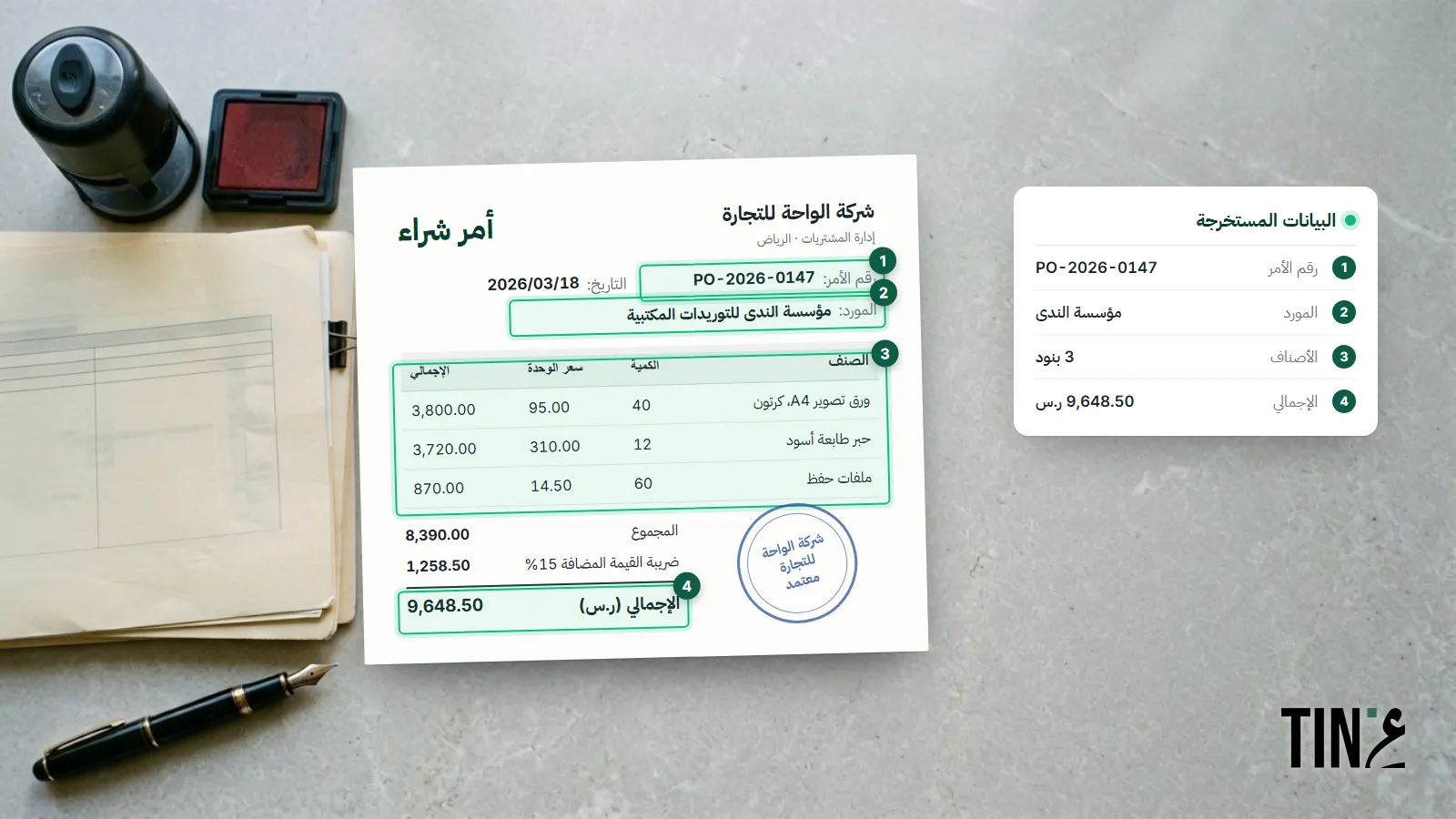
Arabic document automation rarely fails on the whole page. It fails on one field: a misread amount, a swapped date, a lost identifier. Four worked records show the checks that catch it.


In this guide6 sections
- Where does Arabic document automation actually fail?
- How should Arabic digits, dates and identifiers be normalized?
- Run the four fictional purchase-order records
- What happens to a record that fails a check?
- How do you measure a pilot field by field?
- Who owns the data, and how far does the integration go?
- Sources
- Frequently asked
Arabic document automation usually fails quietly. The page reads fine, the OCR text looks right, and one field is wrong: the Arabic decimal mark read as a thousands separator, a day and month swapped in a date, a supplier code that lost its leading zeros. Nothing raises an error; the wrong value simply flows into the ERP. That is why you validate fields, not pages: read the source, extract named fields, and check each proposed value against explicit rules before anything is written to a business system. The interactive example below runs four fictional purchase-order records through those checks, and the sections after it explain how to evaluate a pilot on your own approved documents. It makes no claim about measured OCR accuracy, customer savings or regulatory compliance.
Worked example · no upload or OCR
Try four fictional document records
These prewritten purchase-order fields use SAR as an assumed currency. Pick a case to run the same four local validation rules. No real document or personal data is used.
راسخ للصناعات
مصنع التكييف والدكت · المدينة الصناعية الثانية، الرياض
إحدى شركات مجموعة راسخ القابضة (افتراضية)
أمر شراء
رقم الأمر: 1PO-DEMO-104التاريخ: 52026-09-01
المورّد: مورّد افتراضي للمثال · جهة الطلب: إدارة الصيانة، الخط 2
| الصنف | الكمية | سعر الوحدة | الإجمالي |
|---|---|---|---|
| فلتر هواء لوحدة التكييف | 2٣ | 3٤٠٠٫٥٠ | 4١٬٢٠١٫٥٠ |
مستند افتراضي للتجربة · بدون قيمة
Passes the four example rules
Extracted and normalized
| Field | Source text | Normalized value |
|---|---|---|
| 1Order identifier | PO-DEMO-104 | PO-DEMO-104 |
| 2Quantity | ٣ | 3 |
| 3Unit price (SAR) | ٤٠٠٫٥٠ | 400.50 |
| 4Total (SAR) | ١٬٢٠١٫٥٠ | 1201.50 |
| 5Date | 2026-09-01 | 2026-09-01 |
Expected total: 1201.50 SAR
Validation rules
- PassRequired demo identifier pattern
- PassValid numbers and a positive whole quantity
- PassQuantity × unit price matches the total
- PassA valid, unambiguous YYYY-MM-DD date
Passing is not permission to pay. This fixture does not check supplier identity, duplicates, tax, document authenticity or regulatory compliance. It is not an OCR accuracy benchmark.
Where does Arabic document automation actually fail?
Three steps produce three different outputs. OCR produces recognized text. Field extraction attaches that text to names such as order number, quantity and unit price. Business validation checks each proposed value against explicit rules and, where available, an authorized system of record. A quiet failure can sit in the middle step: the scan is readable and the Arabic text is right, yet the amount lands in the wrong field because a right-to-left table put the unit price where the total should be. A page-level accuracy figure will not show that.
So ask your extraction engine to show where each value came from. Microsoft's analyze-response documentation describes source content, extracted elements, page spans and bounding regions that tie a value back to its place on the page.1 Use that link when your chosen engine provides it, so a reviewer can see the exact words behind a field. The documentation describes that product's API; it is not a claim that we use that product or that every provider returns the same fields.
How should Arabic digits, dates and identifiers be normalized?
Store the original Arabic text next to a normalized value, and never let the normalized value overwrite it. In the fictional example above, the quantity ٣ becomes integer 3, the unit price ٤٠٠٫٥٠ becomes 400.50, and the total ١٬٢٠١٫٥٠ becomes 1201.50. Watch the two marks: ٫ is the Arabic decimal separator and ٬ the thousands separator, and confusing them shifts an amount by a factor of a thousand. The example's parser also accepts Eastern Arabic digits and correctly grouped English numbers. Malformed grouping, an Arabic comma in place of the thousands mark and hidden directional controls fail its numeric check rather than being silently stripped.
Treat identifiers as text: a supplier code with leading zeros is not an amount, and a VAT number is never rounded. Keep currency in its own field. For an ambiguous date such as 01/09/26, ask for the confirmed format instead of guessing which part is the day; Saudi documents can carry Hijri or Gregorian dates, so settle the expected calendar and format for each document type. W3C's bidirectional-text guidance is relevant when Arabic is displayed next to Latin identifiers; the example isolates identifiers and normalized numbers on screen without changing the stored Arabic source.2
Run the four fictional purchase-order records
The example is a prewritten extraction result, not a live OCR demonstration. It contains fictional order PO-DEMO-104, quantity 3, unit price 400.50 and stated total 1201.50. The fixture is deliberately small: no tax, discount, delivery charge, supplier registry or accounting-system lookup. It does not represent a real customer document.
The arithmetic rule is exact for this fixture: 3 × 400.50 = 1201.50. Amounts are held as integer minor units, so the check is 3 × 40050 = 120150, with no floating-point rounding. Four checks run on every record: the identifier pattern, valid numeric syntax, a matching total and an unambiguous, real calendar date. Passing all four means only that the record meets its declared rules, not that the document is genuine or safe to pay.
Select each preset and watch which field fails. The matching record passes. A total of 1200.50 fails arithmetic, the kind of silent error a page-level check would miss. An empty order identifier fails the required-identifier check. The date 01/09/26 fails the unambiguous-date check. The inputs are fixed fictional fixtures; no document upload, model call or business-system write takes place.
What happens to a record that fails a check?
Keep rejected candidates in an exception queue with the source reference, the proposed fields and the checks that failed, so the person who fixes the record sees why it stopped. An approved correction creates a new version; it does not erase the original extraction. A production workflow also needs an idempotency key, duplicate detection and a record of the downstream system's response. These are our implementation recommendations, not features of the small example.
A fully automatic path is reasonable for documents that pass your tested acceptance rules. An ambiguous or conflicting record waits for an authorized correction or stays unprocessed; inventing a missing value to keep the queue moving is how wrong data reaches the ledger. Provider confidence is still useful diagnostic information: Microsoft's confidence guidance describes using the score to decide whether to accept a prediction automatically or flag it for human review.3 Confidence alone does not replace your field rules.
How do you measure a pilot field by field?
Start with one document type and a field dictionary: field name, expected type, whether it is required, permitted formats, reference system and rejection rule. Build an approved evaluation set from your real suppliers, with Arabic and English mixed on the page, scans, multi-page layouts, missing fields and duplicates. Keep the evaluation documents separate from the examples used to configure or train the extractor.
Field exact-match rate is the number of correctly extracted required fields divided by all required fields in the evaluation set, and an absent required field counts as a failure. Incorrect acceptance is the number of accepted documents containing a wrong required value divided by all accepted documents. That second figure measures the silent errors, so it is the one finance should watch. If no documents were accepted, report the denominator as unavailable, not as a zero error rate.
Also record the exception rate, duplicate-write attempts, processing time and the effort to correct each exception. Fix your normalization rules, such as Arabic digit conversion, before scoring, and do not add favorable exceptions after seeing the results. Publish the sample size, document mix, date, tool and version, and the limits beside any measured result. The four fixtures here demonstrate rules; they are not an OCR benchmark or evidence of production accuracy.
Who owns the data, and how far does the integration go?
Before a pilot uses real documents, name the business owner and get the authorization needed to process them. Write down where files and extracted fields are sent, who can open them, how they are retained and deleted, and each selected provider's data-use terms. Ask your privacy and legal owners to set the requirements for the actual data flow. Saudi Arabia's Personal Data Protection Law permits transferring personal data outside the Kingdom only for specified purposes and under conditions (Article 29).4 This guide does not set a blanket hosting, transfer or compliance rule.
Test the handoff to your existing ERP or document system in a non-production environment with five cases: an accepted record, a rejected record, a duplicate submission, a timeout, and a retry after uncertain delivery. Agree who investigates each failure. If you need the fields, evidence and acceptance tests written down before anyone builds, an AI Solution Blueprint specifies them. Custom AI Implementation is our custom AI development for document workflows like this one: it builds and connects the system against those agreed tests.
Practical decision tool
Field-level acceptance checks you can reproduce
- Store the source text and the extracted candidate separately.
- Validate required identifiers, numeric syntax, arithmetic and dates field by field.
- Run all four fictional presets and inspect each failed check.
- Add duplicate detection and integration-failure tests for the real workflow.
- Measure field errors and incorrect acceptance on an independent document set.
The displayed fixtures are fictional purchase orders without tax or additional charges. · The validator does not run OCR, authenticate documents or connect to an ERP. · A successful fixture is not evidence of production accuracy or legal compliance.
Sources
Evidence review ·
Primary sources: regulators, standards and official documentation
- Analyze document response: fields, content and bounding regionsMicrosoft LearnRetrieved: November 6, 2026
- Unicode controls for bidirectional textW3C InternationalizationRetrieved: November 6, 2026
- Interpret accuracy and confidence scoresMicrosoft LearnRetrieved: November 6, 2026
- Personal Data Protection Law (amended, English text)SDAIARetrieved: November 6, 2026Official Saudi government source
Frequently asked
What is the difference between Arabic OCR and document automation?
OCR recognizes text. Document automation adds field extraction, validation, exception handling and integration with a business system. A successful OCR response does not establish that the proposed business record is correct, because the error can sit in a single field.
How should Arabic amounts and mixed-language identifiers be handled?
Keep the source string, normalize amounts with explicit numeric rules, and store identifiers as text. Display Latin identifiers in isolation within RTL text. Reject ambiguous formatting instead of guessing.
Can every Arabic document be processed without human review?
Do not assume so. Define a tested automatic acceptance path and keep uncertain records away from downstream writes. A record that cannot be corrected automatically can stay unprocessed until an authorized person resolves it.
Does a high confidence score prove that a field is correct?
No. Compare field results with independently checked answers and test the rules that accept documents. Track incorrect acceptance alongside field exact-match rate and exception rate.
Is the example a real OCR benchmark or compliance check?
Neither. It validates four prewritten fictional records against declared rules. It does not read an image, measure an OCR engine, verify an invoice's authenticity or establish regulatory compliance.
What should we prepare before an Arabic document automation pilot?
One document type, an approved sample set, a field dictionary, independently checked answers, acceptance rules, an exception owner and a non-production integration target. Settle privacy and data-handling requirements before using real files.
Related guidance
Reviewed on November 7, 2026